
Reviewed · OAXACA TOURS & ACTIVITIES
Ruta mágica de las artesanías
One-day craft road trip, serious art, zero stress. You’ll hit three artisanal towns plus extra stops to see how Oaxaca’s best-known crafts get made, not just sold. The day moves in a tight loop with hotel pickup, so you spend your energy looking instead of navigating.
What I love most is the mix of hands-on process and “go ahead, browse” time. You’ll spend real time in places tied to wood carving, cotton textiles, and barro negro (black pottery), and that matters because crafts here are about skill built over years. One thing to consider: depending on the stop and the day, some segments can feel more retail-focused than demonstration-focused, and this tour may run bilingual (English and Spanish one after the other).
In This Review
- Key highlights at a glance
- Price and logistics: what $53.73 really covers
- Your day plan: timing, pace, and group size
- San Martin Tilcajete: alebrijes where wood becomes a character
- Santo Tomás Jalieza: cotton textiles and huipiles up close
- Ocotlán: the Friday market for ceramics, textiles, and alebrijes
- San Antonino Castillo Velasco: finished textiles you can study
- San Bartolo Coyotepec: barro negro and the charm of black clay
- Guide quality and the bilingual reality (English with Spanish)
- Shopping smart: how not to get carried away
- Who this tour fits best, and who should think twice
- Should you book Ruta mágica de las artesanías?
- FAQ
- How long is the Ruta mágica de las artesanías tour?
- Where does the tour start and end?
- What crafts and towns are included?
- Is the tour in English?
- Do I need to bring snacks or water?
- What is the group size and how many people can go?
Key highlights at a glance
- Alebrijes workshops in San Martin Tilcajete, where wood carving meets bright paint
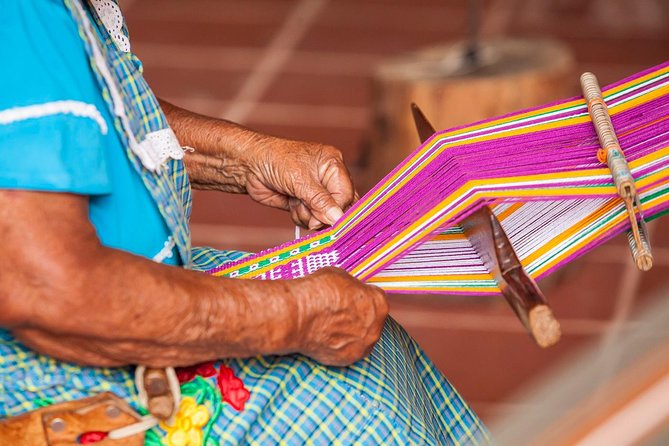
- Huipil and blouse weaving culture in Santo Tomás Jalieza, focused on cotton embroidery
- Ocotlán Friday market style shopping, with a wide range of textiles, ceramics, and alebrijes
- San Antonino Castillo Velasco textiles with finished pieces you can study closely
- Barro negro in San Bartolo Coyotepec, including the black pottery craft process
- Small group size (max 18) plus hotel pickup and drop-off to keep the day smooth
Price and logistics: what $53.73 really covers
At $53.73 per person for an 8-hour day, this tour is mainly paying for three things: (1) the van and driver to get you out of Oaxaca City, (2) a local guide who can explain what you’re seeing, and (3) your structured time in multiple craft centers. Since admission is free at the stops listed here, you are not getting hit with separate entry fees at every town.
Hotel pickup and drop-off is a big value piece. Oaxaca’s craft towns are outside the city, and doing that by yourself means extra time, extra taxis, and more chance of showing up at the wrong hour. This format also helps if you only have a day or two in town and want your “craft education” to feel efficient.
The “not included” part is also practical to plan for. Snacks and bottled water are not included, so I’d treat this like a long walking day. Bring money for snacks or plan to buy something along the way. And yes, you’ll want water even if the weather looks mild in the morning.
Backup plans for Oaxaca City
- Hierve el Agua, Tule Tree, Mitla and Mezcal Distillery Tour
★ 4.5 · 1,094 reviews - Explore Hierve el Agua, Mitla, Tule, Textile and Mezcal for a day
★ 5.0 · 1,043 reviews - Monte Alban Guided Half Day Tour
★ 5.0 · 880 reviews
Your day plan: timing, pace, and group size
This starts at 9:30 am, with the meeting point at 5 de Mayo 300, RUTA INDEPENDENCIA, Centro, Oaxaca de Juárez. The tour ends back at that same meeting point.
The schedule is built around short visits:
- San Martin Tilcajete: about 1 hour
- Santo Tomás Jalieza: about 1 hour
- Ocotlán: about 1 hour
- San Antonino Castillo Velasco: about 1 hour 30 minutes
- San Bartolo Coyotepec: about 40 minutes
That adds up fast, which is the trade. You will see a lot of craft categories, but you won’t have a full day to get truly intimate with every single step of every process. Still, the pace can be perfect if your goal is to compare styles across towns and decide what you actually want to buy (or what craft you want to come back for later).
Group size is limited to 18 travelers, which keeps things from turning into a full bus crawl. That said, you should still expect some waiting around when groups move between studios, showrooms, and market areas.
San Martin Tilcajete: alebrijes where wood becomes a character
Your first craft stop is San Martin Tilcajete, famous for wood alebrijes. This is the kind of place where the artistry is obvious from the street, but the real payoff is inside the local workshops.
In the workshop setup, you can usually watch the key stages come to life: carving the figure, then decorating it with bright colors. Alebrijes are playful on the surface, but the craft work is disciplined. Even in a short visit, you can learn to look for things like proportions, carving detail, and how the paint is applied so the figure feels crisp and alive.
What to watch for during your time there:
- Do you see artists preparing paint or applying it in layers?
- Are the figures finished with care on the small details, not just the big shapes?
- Can you ask what makes one piece more complex than another?
One realistic consideration: with only about an hour, you may not get the full “from raw material to final paint” story for every figure. If you want maximum demonstration time, spend your questions early and keep your attention on what the artists are actively doing in front of you.
Santo Tomás Jalieza: cotton textiles and huipiles up close

Next is Santo Tomás Jalieza, known for textiles and embroidered cotton, especially huipiles and embroidered blouses. This is where the day shifts from carved objects to fabric work, and that change can be surprisingly educational.
Here, the focus is on how artisans make garments by hand, with attention on the intricate embroidery and traditional techniques. Textile crafts can be hard to judge from photos. Up close, you start noticing how designs line up, how thread work looks at different angles, and whether the finish seems careful or rushed.
If you like textiles, this stop is one of the best uses of your time. But there is also a common catch in craft tours: not every shop functions like a live demonstration space. Sometimes you’ll see the craft clearly. Other times, you may end up in a sales area where you can examine pieces but not watch the full process.
Practical tip: move slowly. Look at the stitching density, the symmetry of patterns, and the way colors hold up across the whole garment. If you’re buying a blouse or huipil, you’re also buying durability and craftsmanship, not just a design.
Close by, worth a second look:
- AUTHENTIC OAXACA CULTURAL FOOD TOUR, eat like a local.
★ 5.0 · 462 reviews - Half day tour to Monte Albán
★ 4.5 · 420 reviews - Boil the water and distillery mezcal tour
★ 5.0 · 413 reviews - Immersion Tour and Oaxaca Markets, All gastronomy included
★ 5.0 · 386 reviews
Ocotlán: the Friday market for ceramics, textiles, and alebrijes

Then you get the market energy in Ocotlán, known especially for its Friday market. Markets can be hit or miss on tours, but this one has a distinct advantage: it’s a real place where local makers sell, not only a curated stop.
You’ll likely see a spread of crafts, including:
- textiles
- ceramics
- colorful alebrijes
This is also the part of the day where your shopping instincts kick in. If you want variety in one place, this is where you can compare items across sellers quickly. If you’re trying to avoid buying something overpriced, markets are where you can check prices and spot what looks truly well made.
One caution: market areas can be large and easy to lose your group in for a minute, especially if you’re focused on product. Stay close to your guide, and agree on a meeting spot or clear “check-in” time in your head.
Cash is another practical issue. Some stops on this route may be cash only, and the market is often where that shows up. Plan to carry some pesos so you’re not stuck mid-browse.
San Antonino Castillo Velasco: finished textiles you can study
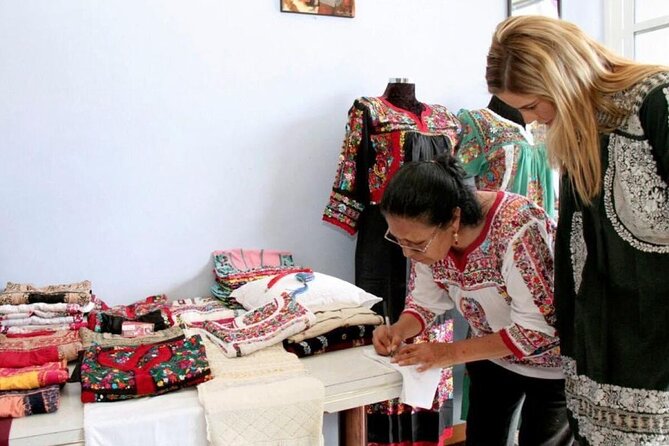
After the market, you head to San Antonino Castillo Velasco, another textiles-focused stop. Here, the emphasis is on delicate embroidery and the kind of garments that are already finished when you see them.
You get about 1 hour 30 minutes at this location, which is longer than most of the stops. That extra time helps because you can actually compare details across multiple pieces. If you’ve ever bought a textile elsewhere and later realized the photo lied, you’ll appreciate this kind of on-site looking.
What I like about this stop is the chance to learn by observation:
- How do designs repeat across sleeves and panels?
- Do borders look tidy and evenly spaced?
- Does the fabric look stable and not overly stretched?
One drawback to keep in mind: if you’re the type who wants nonstop demonstrations, a stop featuring mostly finished pieces may feel more like a showroom. Still, for many people this is exactly what they came for, because finished textiles are what you might take home.
San Bartolo Coyotepec: barro negro and the charm of black clay
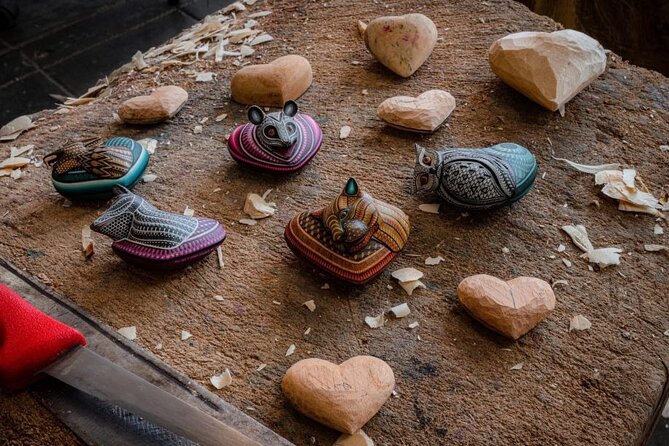
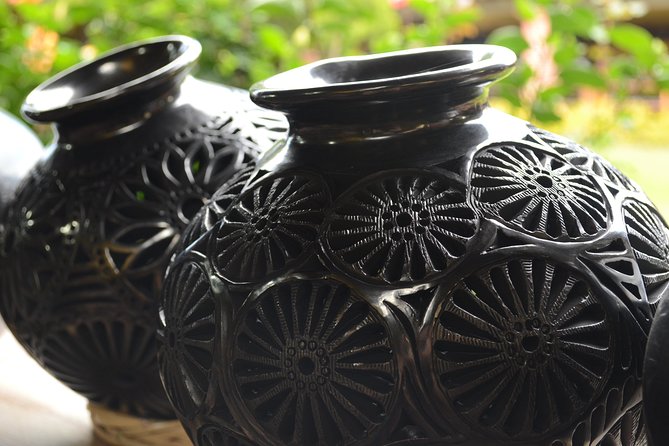
You end with San Bartolo Coyotepec, where black pottery (barro negro) is the star. This is a famous craft tradition, and this area is where you can slow down a bit mentally and appreciate the craft logic.
The stop includes workshops and local shops with pieces ranging from useful items to decorative pieces. You may also get to see part of the making process, which is key with pottery. A black clay piece is not just painted. The material and process give it that look, and watching even one stage helps you understand what makes it special.
This is the kind of craft where you’ll benefit from handling items carefully:
- Check the finish under different light.
- Look for smoothness and consistency in color.
- Pay attention to edges and where the piece meets itself in forming.
Time is shorter here (about 40 minutes), so if you want to shop, decide what you’re after before you start circling. Pottery can be heavy and fragile, so think about transport early.
Guide quality and the bilingual reality (English with Spanish)

The tour is offered in English, but the day can still be bilingual depending on the guide and how they manage the group. In some cases, you may hear the same explanation in Spanish and then again in English, which can make the conversation feel slower.
That’s not necessarily bad. Explanations about craft meaning, symbols, and local technique can be complex. Still, if you strongly prefer one language, treat this as a “you might hear repeat phrasing” tour.
Names you may hear from guides include Moses and Clemente, and drivers have included Francisco. Having a friendly, clear guide can make the difference between seeing objects and understanding why they matter.
Shopping smart: how not to get carried away
Here’s the balancing act with craft tours: you want to buy directly from makers, but you also want to feel in control. The good news is the structure gives you multiple chances to shop, without requiring that you purchase at every stop.
Use this approach:
- At alebrijes and pottery stops, focus on craftsmanship first. Details matter.
- At textile stops, study the stitching and finishing before you commit.
- At the market, compare. Don’t buy the first thing that catches your eye.
Also, plan on a mix of payment types. Some parts of this route may take credit cards, while others may be cash only, especially woven items and the market area. It’s smart to carry a bit of cash even if you plan to pay with card.
And one more practical truth: you can fall into the “spend all my time looking at the most expensive thing” trap. If you set a rough budget before you get picked up, you’ll enjoy the day more. You can still buy something special, just without the stress.
Who this tour fits best, and who should think twice
This route is a strong match if you want:
- a fast overview of Oaxaca’s craft regions in one day
- chances to see wood carving, embroidery, and black pottery
- a guided framework that makes shopping easier (and safer for your wallet)
It’s also great if you enjoy comparing styles across towns. You’ll see different craft priorities in each place, and that makes the differences stand out.
Think twice if:
- you expect nonstop live demonstrations at every stop
- you dislike tours where explanations repeat in multiple languages
- you want a long, slow deep study of one craft category only
This is a “variety and selection” day. If you want a “one craft, fully explained, for hours,” you may be happier with a longer workshop-focused option later.
Should you book Ruta mágica de las artesanías?
I’d book this tour if you’re short on time and you want an efficient, well-paced craft sampler that includes both workshop-style viewing and shopping opportunities. The hotel pickup, the small group size, and the mix of alebrijes, textile traditions, and barro negro make it a solid value for $53.73.
Skip or reconsider if you’re the type who gets frustrated by sales pressure, shop floors, or bilingual pacing. In that case, ask yourself what matters more: seeing craft makers up close, or hearing uninterrupted explanations in your preferred language.
If you want a practical takeaway, here it is: bring cash, bring patience, and keep your questions focused early in each workshop. You’ll leave with better buys, not just better photos.
FAQ
How long is the Ruta mágica de las artesanías tour?
It runs for about 8 hours.
Where does the tour start and end?
It starts at 5 de Mayo 300, RUTA INDEPENDENCIA, Centro, Oaxaca de Juárez and ends back at the same meeting point.
What crafts and towns are included?
You visit San Martin Tilcajete (wood alebrijes), Santo Tomás Jalieza (embroidered cotton textiles), Ocotlán (Friday market), San Antonino Castillo Velasco (textiles), and San Bartolo Coyotepec (black pottery).
Is the tour in English?
Yes, it is offered in English.
Do I need to bring snacks or water?
Yes. Snacks and bottled water are not included, so plan to buy some during the day.
What is the group size and how many people can go?
The tour has a maximum of 18 travelers. Free cancellation is available up to 24 hours before the start time.
Just added around Oaxaca City
- Wood Engraving Workshop★ 5.0 · 21 reviews
- Oaxaca Walking Tour★ 5.0 · 32 reviews
- Culture, History and Food in Oaxaca City★ 5.0 · 43 reviews
- Private and Secure Transfer Hotel to Oaxaca Airport★ 5.0 · 33 reviews
- Tour Monte Albán “clasico”★ 4.5 · 148 reviews
- Private and safe transfer from the airport to the hotel in Oaxaca★ 4.5 · 58 reviews
- Ultimate Hierve el Agua Hike + Textile Art★ 5.0 · 42 reviews
- Street Food and 3 Markets Tour, Meat or Veggie Options★ 5.0 · 35 reviews
Oaxaca Tours & Activities, compared.

Hierve el Agua, Tule Tree, Mitla and Mezcal Distillery Tour
Read our review →
Explore Hierve el Agua, Mitla, Tule, Textile and Mezcal for a day
Read our review →

Hierve el Agua, Mitla, El Tule Tree, Rugs, Mezcal Distillery Tour
Read our review →
AUTHENTIC OAXACA CULTURAL FOOD TOUR, eat like a local.
Read our review →

Browse the lists this tour appears in